Have you ever ended a workday not knowing your exact stock levels? Or waited days for a report your team compiled by hand? Perhaps you discovered a GST mismatch only after a notice arrived.
If so, you already understand the problem that ERP software was built to solve. You just may not have known there was a name for it.
In this guide, we explain what ERP software is, how it works, and why Indian businesses are adopting it faster than ever in 2026. There is no jargon here. Just the facts you need to make a confident decision.
What Is ERP Software? A Simple Definition
ERP stands for Enterprise Resource Planning. Despite the formal name, the idea is simple.
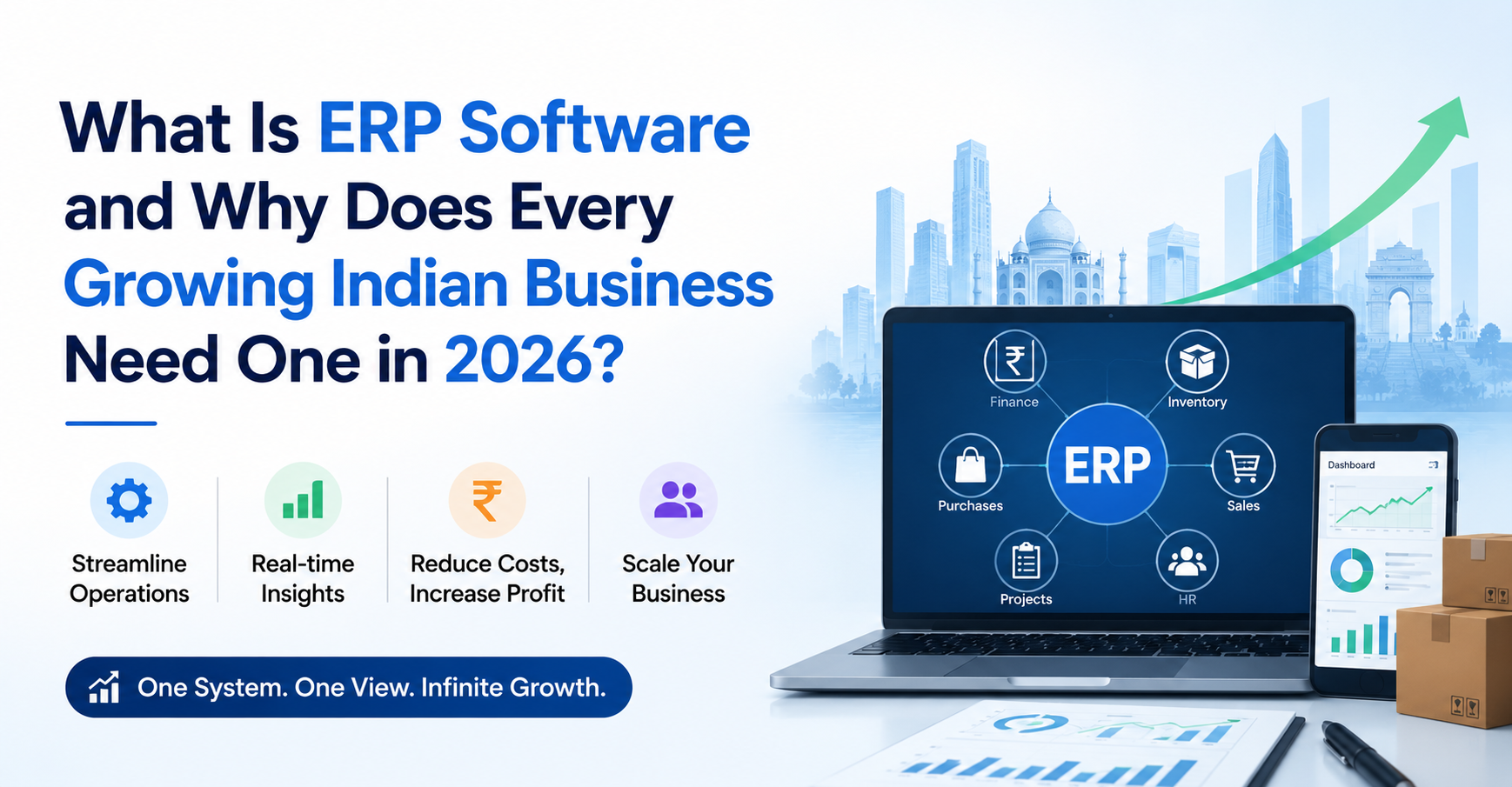
ERP software is a single platform that connects all the key functions of your business. These include finance, procurement, inventory, sales, production, HR, and reporting. As a result, every department works from the same data, in real time, without delays or errors.
The Problem ERP Solves
Think about how most Indian businesses currently operate. The accounts team works in Tally. The warehouse team tracks stock in Excel. The sales team logs orders on WhatsApp. Management then waits for someone to compile a weekly report from all three sources.
This approach creates three serious problems. First, data gets entered more than once, which leads to errors. Second, departments make decisions based on different numbers. Third, management never gets a clear, real-time picture of the business.
An ERP system fixes all of this. One entry. One source of truth. Every function connected.
Think of it as the central nervous system of your business. When a sale is confirmed, your inventory updates automatically. When stock falls below a set level, a purchase order is triggered. Everything flows together, without anyone having to chase information.
How Did ERP Software Evolve?
ERP systems started in manufacturing in the 1960s. Back then, they were called MRP systems, short for Material Requirements Planning. Their job was simple: tell factories what raw materials to order and when.
Over the following decades, however, these systems expanded. They began covering finance, HR, sales, and customer management. By the 1990s, the term ERP had become the standard name for any integrated business management platform.
ERP in India Today
Today's ERP systems look very different from those early tools. They are cloud-based, mobile-friendly, and powered by artificial intelligence. Moreover, they are built with India-specific requirements in mind. This includes GST compliance, e-invoicing under GSTN, TDS management, and e-way bill integration.
The Indian ERP market is growing at a rate of 11.4% per year. This growth is driven by the government's Digital India initiative, rising demand from small and mid-sized businesses, and stricter compliance requirements across all industries.
That growth is not a coincidence. It reflects a simple truth: businesses with ERP grow faster and make better decisions than those without it.
What Does ERP Software Actually Do?
An ERP system is made up of modules. Each module covers a specific part of your business. Most platforms let you start with the modules you need and add more as you grow.
Finance and Accounting
This module handles your entire financial operation. It covers journal entries, bank reconciliation, GST return preparation, e-invoicing, TDS management, and financial reporting. Instead of your accounts team spending days closing the books each month, the ERP produces real-time financial statements at any time.
Inventory and Warehouse Management
This module tracks your stock levels across every location in real time. When a sale is confirmed, inventory reduces automatically. When stock drops below a set level, a purchase request is raised. Furthermore, it handles batch tracking, serial numbers, and FIFO or FEFO stock rotation rules.
Procurement and Purchase Management
This module manages your entire buying process. It covers purchase requests, vendor quotes, purchase orders, goods receipt, and invoice matching. Approval rules ensure every purchase is authorized before money is spent.
Sales and Order Management
From customer quote to delivery and invoice, the full sales cycle runs within the system. Pricing rules, credit limits, discount approvals, and customer-specific terms are all enforced automatically. As a result, your sales team spends less time on admin and more time selling.
Production and Manufacturing Planning
For manufacturers, this module handles Bill of Materials (BOM) management, production orders, Material Requirements Planning (MRP), and shop floor tracking. In short, it tells your team what to make, when to make it, and whether the materials are available before a problem occurs.
HR and Payroll
This module covers employee records, attendance, leave, performance, and payroll. It handles Indian statutory requirements including PF, ESIC, and professional tax. Additionally, payroll entries post directly to the finance module, so no double entry is needed.
Reporting and Business Intelligence
Pre-built dashboards give management real-time visibility across the business. You can track margins by product, inventory turnover, debtor aging, and sales performance by region or team. Therefore, decisions are based on live data, not last month's spreadsheet.
Why Is 2026 the Most Important Year for ERP in India?
Indian businesses have faced pressure to digitize for years. In 2026, however, that pressure has become impossible to ignore. Several major forces are converging at the same time.
GST Compliance Has Become Real-Time
India's GST system has moved toward real-time enforcement. E-invoicing is now mandatory above a certain turnover threshold. The government's AI-powered audit systems cross-reference your GSTR-1, GSTR-2B, and e-invoice data automatically. As a result, a mismatch that once went unnoticed for months is now flagged within days.
Manual accounting simply cannot keep up with this level of scrutiny. ERP systems with built-in GST compliance handle IRN generation, e-way bill filing, and ITC reconciliation automatically. Consequently, the risk of errors and penalties drops significantly.
The Cost of Manual Work Keeps Growing
Every manual entry is a potential error. Every spreadsheet is a version control risk. Every disconnected system creates a reporting delay. These problems feel manageable when a business is small. However, as companies grow, the cost of manual operations compounds quickly.
Businesses that implement ERP do not just save time. They eliminate entire categories of risk.
Your Competitors Have Already Upgraded
Businesses in your industry are making technology decisions right now. Those with real-time inventory visibility, automated procurement, and AI-assisted planning can serve customers faster and respond to market changes more quickly.
According to industry research, companies using ERP systems have reported inventory turnover improvements from 15 to 16 times per year to 23 to 24 times per year. Furthermore, equipment uptime improved by 40% in manufacturing environments. These are not small gains. They are the kind of advantages that separate growing businesses from stagnant ones.
AI Is Now Built Into ERP
Modern ERP platforms in 2026 use artificial intelligence to forecast demand, flag unusual transactions, automate approvals, and surface business insights in real time. In other words, they do not just store your data. They actively help you use it better.
Businesses that adopt AI-enabled ERP now are building an advantage that compounds over time.
What Kind of Indian Business Needs ERP?
The simple answer is: any business that has outgrown its current tools. More specifically, ERP makes sense when your business shows one or more of these signs.
Your Departments Work from Different Numbers
When your sales team's figures do not match your accounts team's figures, and neither matches the warehouse records, you have a data problem. Only an integrated system can solve it at the root.
GST Compliance Takes Too Long
If your accounts team spends more than a day on monthly GST filing, or if you have received GST notices for ITC mismatches, your compliance process has a structural gap. ERP automates this entirely.
You Cannot Trust Your Inventory
If your physical stock count regularly differs from your recorded stock, you are making purchasing and sales decisions based on wrong information. This has direct financial consequences.
Reports Require Too Much Manual Work
If management waits days for monthly reports compiled in Excel, your decision-making speed is being held back by your tools. ERP gives you those reports instantly, at any time.
Your Business Has Grown Across Locations
Managing inventory, finance, and operations across multiple branches or warehouses without a central system is one of the most common causes of margin loss in growing Indian businesses.
How to Choose the Right ERP Software in India
Choosing the wrong ERP — or the right ERP with the wrong partner — is a costly mistake. Here is what to look for.
India-Ready Compliance
Your ERP must handle GST natively, not through a workaround. This means automatic IRN generation, e-way bill integration, multi-GSTIN support, TDS management, and ITC reconciliation. These are non-negotiable for any business operating at scale in India.
Industry Fit
A trading company needs fast order processing and credit management. A manufacturer needs BOM management and MRP. A pharma company needs batch traceability and quality control. Therefore, always choose a platform that has been successfully implemented in your specific industry, not just one that claims to cover everything.
Total Cost of Ownership
ERP pricing has many parts: license fees, implementation, data migration, training, customization, and annual support. A realistic first-year budget for an Indian SME with around 20 users typically falls between Rs. 8 lakh and Rs. 15 lakh. Always ask for a full-scope quote. More importantly, evaluate ROI. Most businesses recover their ERP investment within 12 to 18 months through operational savings.
Implementation Partner Quality
This is the factor most businesses underestimate. The ERP platform is the tool. However, the implementation partner is the expert who makes it work for your specific business. An experienced partner with knowledge of your industry configures the system to match your real workflows, migrates your data correctly, and trains your team effectively.
Post-Go-Live Support
ERP is not a one-time project. Your business will change, regulations will evolve, and your team will grow. As a result, you need a partner who provides reliable, ongoing support, not one who disappears after go-live.
Which ERP Platforms Work Best for Indian Businesses?
Several credible ERP options are available in the Indian market. Each suits a different type of business.
SAP Business One
SAP Business One is purpose-built for small and mid-sized businesses. It is one of the most widely implemented ERP platforms in India, covering manufacturing, trading, logistics, pharma, food and beverage, and chemicals. It offers deep functionality, strong GST compliance, and a well-established partner network.
Fairfax Solution is an SAP PE Partner with over 15 years of experience and 80+ successful implementations across India.
Zoho One
Zoho One is Zoho's all-in-one business platform. It covers CRM, accounting, HR, inventory, analytics, and more. It is particularly strong for businesses that want a cloud-native, affordable platform without the complexity of traditional ERP. Fairfax Solution is also an Accredited Zoho Partner, offering certified Zoho implementation and ongoing support.
Tally Prime
Tally Prime remains a widely used accounting tool for very small businesses. It is, however, primarily an accounting solution rather than a full ERP. For this reason, many businesses use Tally as a starting point before transitioning to a more complete ERP system as they grow.
The right platform depends on your industry, size, and process needs. There is no universal answer, which is precisely why honest advice from an experienced implementation partner matters so much.
Common ERP Mistakes Indian Businesses Make
Understanding what goes wrong helps you avoid the same errors.
Choosing on Price Alone
The lowest-cost quote almost always leaves something out — implementation depth, training hours, or post-go-live support. In most cases, the total cost of a cheap implementation ends up being higher than a well-scoped engagement done correctly the first time.
Skipping Process Mapping
Implementing software without first reviewing your current processes means you automate the wrong things. Good implementation always starts with understanding how your business actually works.
Under-Training the Team
Research shows that under-trained teams use only 40% of ERP features after go-live. As a result, most of the ROI is lost. Role-based training for every user group is essential, not optional.
Treating Go-Live as the Finish Line
The first 30 to 60 days after go-live are when good habits are formed — or bad ones are reinforced. Businesses with strong support during this period achieve lasting adoption. Those without it often revert to old tools alongside the new system.
Choosing a Partner Without Industry Experience
A consultant experienced in retail may not understand the compliance or production needs of a pharmaceutical manufacturer. Industry knowledge in your specific sector is a prerequisite for a successful implementation, not a bonus.
What ROI Can Indian Businesses Expect from ERP?
Return on investment from ERP comes from several directions at once.
Time savings come from eliminating manual entry, report compilation, and inter-department follow-up. For a 20-person business, this often amounts to dozens of hours per week returned to productive work.
Inventory cost reduction typically ranges from 15% to 30% after implementation, because purchasing decisions are based on accurate, real-time stock data rather than estimates.
Compliance cost reduction results from automated GST filing, e-invoicing, and ITC reconciliation. These eliminate the time and professional fees currently spent managing compliance manually.
Faster decisions are possible because management dashboards update in real time. Consequently, problems are identified and addressed in hours rather than weeks.
Revenue protection comes from better order management, faster fulfilment, and improved customer service. Together, these reduce the silent customer attrition that often goes unnoticed without proper tracking.
How Fairfax Solution Helps
Fairfax Solution has been implementing ERP for Indian businesses for over 15 years. With 80+ successful go-lives across manufacturing, trading, logistics, pharma, food and beverage, and chemicals, our team brings the depth and discipline that turns ERP into real business results.
As an SAP PE Partner and an Accredited Zoho Partner, we work with two of the most capable business platforms available in India today. Our role is to understand your business thoroughly, recommend the right platform honestly, implement it with care, and support you long after go-live.
We do not use generic templates. Every client gets a solution built around their specific workflows, industry requirements, and compliance obligations.
Conclusion: The Right Time Is Now
The question most Indian business owners ask about ERP is not "should we do this?" It is "when should we start?"
In 2026, the answer is clear. GST compliance is tightening. Competition is moving faster. And the cost of staying on disconnected, manual systems is rising every month.
The businesses that will lead their industries in 2030 are making technology decisions today. ERP is not simply a software purchase. It is a business decision that determines how fast you grow, how reliably you comply, and how confidently your team makes decisions every day.
If you are ready to have that conversation, Fairfax Solution is ready to help.
Fairfax Solution — SAP PE Partner | Accredited Zoho Partner
Offices: Sector V, Kolkata | Greater Noida West, Uttar Pradesh
Phone: +91 98891 12727 | Email: sapsales@fairfaxsolutions.net
Website: fairfaxsolution.com
Frequently Asked Questions
What is ERP software in simple terms?
ERP software is a single platform that connects all departments of your business — finance, inventory, sales, procurement, production, and HR — so everyone works from the same live data. It replaces disconnected tools like Tally, Excel, and WhatsApp with one integrated system.
Which Indian businesses need ERP software?
Any business that has outgrown its current tools. Common signs include unreliable inventory data, GST compliance taking too long, reports that need manual compilation, or departments working from different figures.
How much does ERP cost in India?
A realistic first-year investment for an Indian SME with around 20 users is between Rs. 8 lakh and Rs. 15 lakh. This covers license fees, implementation, data migration, training, and support. Most businesses recover this investment within 12 to 18 months.
What is the best ERP for Indian SMEs in 2026?
SAP Business One suits mid-sized businesses in manufacturing, trading, logistics, and pharma. Zoho One suits businesses seeking a cloud-native, modular platform. The right choice depends on your industry and process complexity.
What is the difference between ERP and Tally?
Tally is an accounting and GST compliance tool. ERP covers your entire business — inventory, procurement, production, sales, CRM, and HR — all in one integrated system. Tally is where many businesses start. ERP is where they go when they are ready to grow.
How long does ERP implementation take in India?
For a typical Indian SME with 10 to 50 users, implementation takes between 8 and 16 weeks, depending on complexity, integrations, and data migration volume.




 June 23, 2026