Inventory creates a difficult balance for growing businesses.
Too much stock ties up working capital, increases carrying costs and creates the risk of obsolete inventory.
Too little stock can result in stockouts, delayed deliveries, lost sales and production interruptions.
The challenge is knowing how much inventory you actually need, where you need it and when you need it.
This is where SAP Business One inventory forecasting and Material Requirements Planning (MRP) can become important.
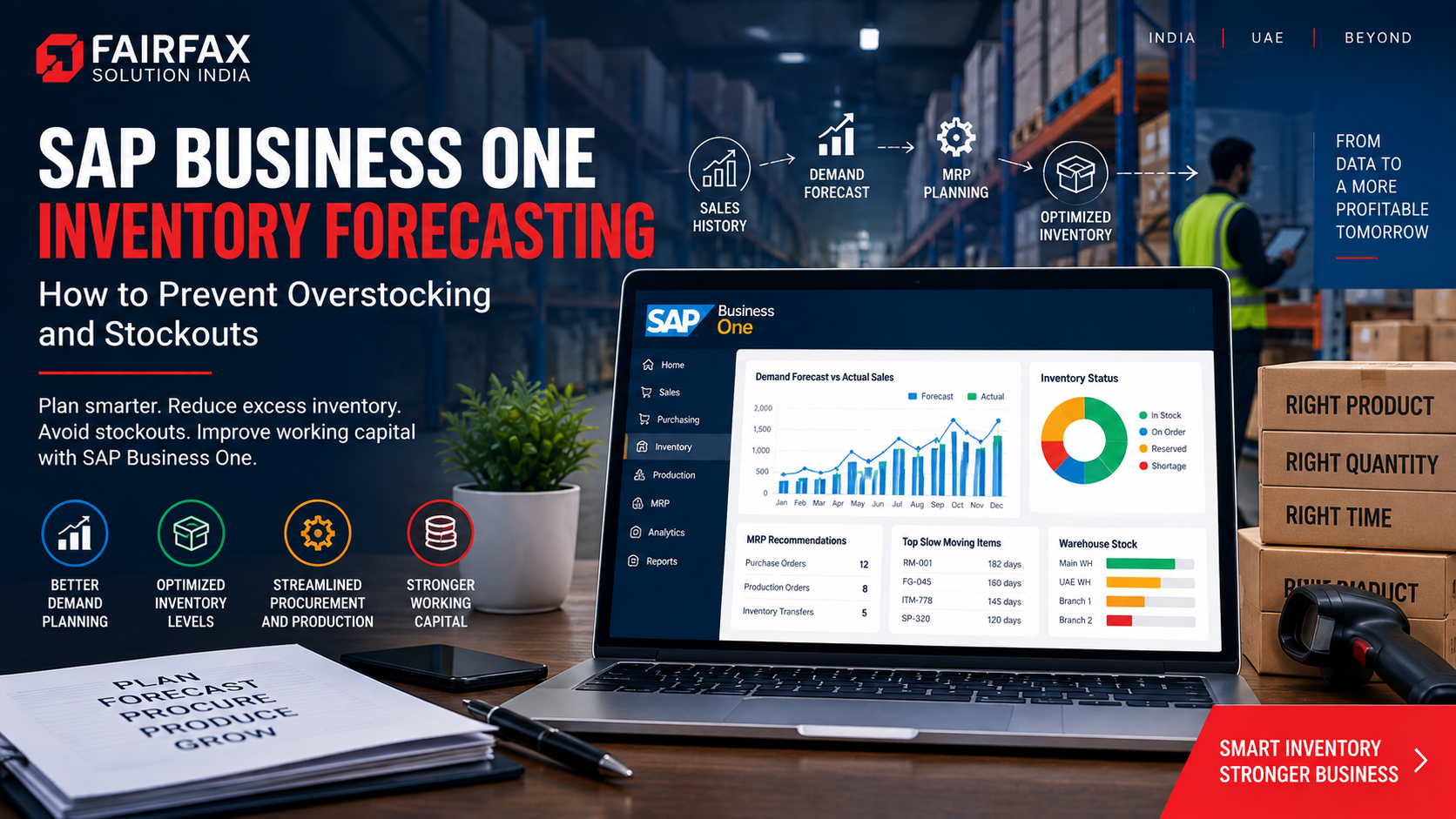
SAP Business One allows businesses to create forecasts by item and warehouse using daily, weekly or monthly periods. These forecasts can then be used as inputs for MRP calculations.
Why Traditional Inventory Planning Falls Short
Many businesses still rely on:
- Excel spreadsheets
- Manual reorder calculations
- Previous-month sales
- Individual buyer experience
- Static minimum stock levels
- Separate warehouse reports
These methods can work at a small scale.
However, as SKU counts, warehouses, suppliers and sales channels increase, manual planning becomes difficult.
A business may have inventory sitting in one warehouse while another location faces a shortage.
That is not necessarily an inventory problem.
It is often a visibility and planning problem.
How SAP Business One Inventory Forecasting Works
SAP Business One can use historical sales information to generate forecasts. Forecasts can then become an additional data source for MRP planning.
The planning process can consider factors such as:
- Current inventory
- Sales orders
- Purchase orders
- Production orders
- Forecast demand
- Bill of Materials (BOM)
- Lead times
- Minimum order quantities
- Order multiples
- Inventory transfers
SAP's MRP process uses these inputs to calculate requirements and generate recommendations for purchasing, production or inventory movement.
This changes the planning question from:
“How much stock do we have?”
to:
“Will we have enough stock when the business actually needs it?”
1. Forecast Demand Before the Stockout Happens
Historical sales data can provide a starting point for demand forecasting.
SAP Business One allows forecasts to be generated based on sales history and adjusted using percentage increases or decreases where required.
For example, a distributor expecting higher seasonal demand can adjust its forecast before placing procurement orders.
This gives the purchasing team more time to respond.
2. Use MRP to Connect Demand With Supply
Forecasting alone is not enough.
The next step is connecting expected demand with available and planned supply.
SAP Business One MRP evaluates inventory, demand and supply and produces recommendations based on the defined planning parameters.
Depending on the business scenario, recommendations can support:
Purchase → Production → Transfer
This helps procurement and production teams plan against actual requirements instead of relying purely on manual calculations.
3. Factor in Lead Time and Order Constraints
A common mistake is looking only at quantity.
Timing matters just as much.
An item may technically have sufficient supply coming in, but if the purchase order arrives after the required date, the business still has a stockout.
SAP Business One MRP considers planning parameters such as:
- Lead time
- Minimum order quantity
- Order multiples
- Order intervals
- Tolerance days
These parameters influence the resulting MRP recommendations.
This is particularly important for businesses dealing with imported products, long supplier lead times or production dependencies.
4. Manage Inventory by Warehouse
Inventory planning becomes more complicated when a business operates multiple warehouses.
SAP Business One MRP can be configured to plan inventory, demand and supply by company or by warehouse.
This can help identify situations such as:
Warehouse A: Excess inventory
Warehouse B: Stockout risk
Instead of immediately purchasing additional stock, management can evaluate whether an inventory transfer is more appropriate.
That can reduce unnecessary procurement and improve inventory utilization.
5. Connect Forecasting With Production Planning
For manufacturers, inventory forecasting cannot stop with finished goods.
Demand for a finished product can create dependent demand for its components.
SAP Business One MRP works through the BOM structure to calculate requirements for lower-level components.
For example:
Customer Demand → Finished Product → BOM → Raw Materials → Procurement
This allows production planners to identify material requirements earlier.
The result can be better production scheduling and fewer material shortages.
What Businesses Should Monitor
Better inventory forecasting is not just about increasing forecast accuracy.
Businesses should monitor operational KPIs such as:
- Inventory turnover
- Stockout frequency
- Excess inventory
- Slow-moving inventory
- Stock aging
- Service level
- Purchase lead time
- Forecast accuracy
- Working capital tied up in inventory
These metrics help management understand whether inventory is actually supporting profitability.
The Real Business Benefit
The objective is not simply to keep less inventory.
It is to keep the right inventory.
That means having sufficient stock to meet customer and production requirements without unnecessarily tying up cash.
For distributors, this can improve replenishment and service levels.
For manufacturers, it can improve material availability and production planning.
For multi-warehouse businesses, it can improve stock allocation and visibility.
And for finance teams, better inventory planning can contribute to stronger working-capital management.
Final Takeaway
Inventory forecasting should not be an isolated spreadsheet exercise.
Demand forecasting + inventory visibility + MRP + procurement + production planning should work together.
SAP Business One provides forecasting and MRP capabilities that can connect expected demand with available inventory and planned supply.
The result is a more structured approach to answering three critical questions:
What do we need?
How much do we need?
When do we need it?
For businesses in India and the UAE, especially manufacturers, distributors and trading companies, that visibility can make inventory management a strategic business function rather than a daily firefighting exercise.
Want to improve inventory planning with SAP Business One?
Fairfax Solutions can help assess your current inventory, procurement and MRP processes and design an SAP Business One environment around your operational requirements.




 September 17, 2026