Ask any MD of a growing manufacturing business what their biggest operational frustration is and a version of the same answer comes up with surprising frequency: "By the time I get the numbers, the moment to act has passed."
This is not a management failing. It is an architecture problem. And it is incredibly common.
The Operational-Financial Data Gap
In most manufacturing businesses without integrated ERP, financial data lags operational reality by weeks. Goods are shipped, but the invoice isn't raised for three days. Raw materials are consumed in production, but the material issue entry isn't updated until Friday. A customer returns a batch, but the credit note takes a week to get processed.
Each of these delays is individually small. Cumulatively, they mean that your Profit & Loss statement is always a historical document — a record of decisions already made, not a tool for decisions being made now.
Tally and similar accounting-first tools make this worse because they sit downstream from operations. Someone has to take what happened in the warehouse, on the shop floor, and in the sales team, and enter it into the accounting system. That someone is usually already busy with a dozen other things. So the entries come in late, incomplete, or wrong.
What Integration Actually Means in Practice
SAP Business One doesn't separate operational and financial data. They are the same data, flowing through one system.
When a delivery is made to a customer, the inventory entry, the accounts receivable entry, and the revenue recognition entry happen simultaneously — because the delivery document is the trigger for all three. There's nothing to "reconcile" later because there was never a gap.
When raw materials are issued to production, the material cost is immediately allocated to the production order. WIP accounting is live, not reconstructed at month-end. Your cost accountant knows the cost of every production order as it progresses — not after it closes.
When a purchase invoice is received and matched to a goods receipt, the vendor liability is posted automatically. Three-way matching (PO, GRN, invoice) happens in the system — preventing duplicate payments and ensuring that only what was actually received is paid for.
When a payment is collected from a customer, the accounts receivable balance updates immediately. Your finance team has a live view of outstanding receivables — who owes what, for how long — without running a report or making a phone call.
What the MD Sees on Day One
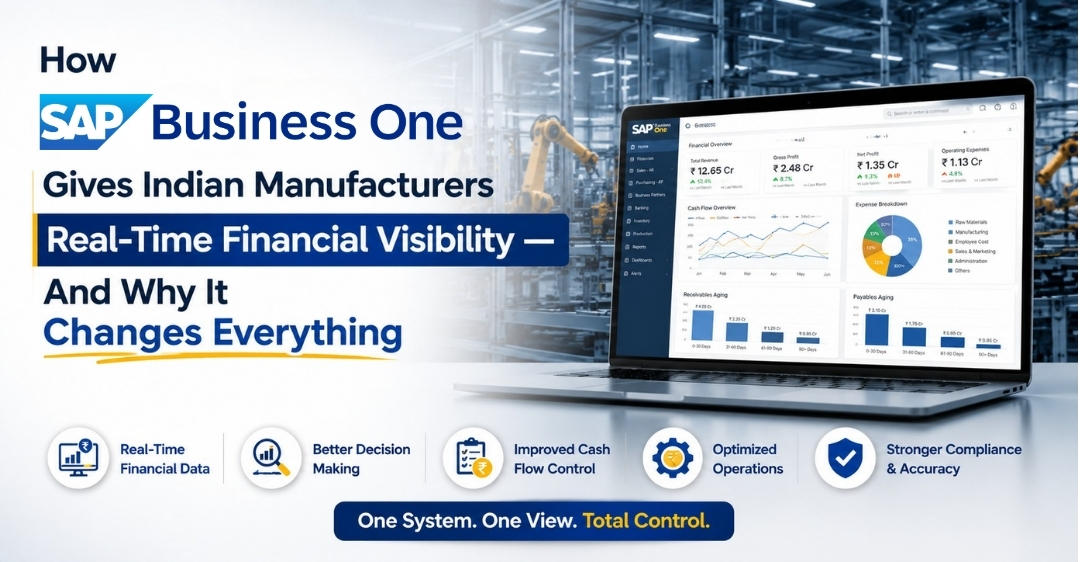
With SAP Business One properly implemented, the management dashboard becomes genuinely useful. Revenue by customer, by product, by region — live. Gross margin by product line — live. Inventory value across all locations — live. Customer outstanding ageing — live. Cash position — live.
The month-end close goes from a 10-day reconciliation exercise to a two-day review process — because the data has been accumulating accurately all month, not being reconstructed from paper trails.
More importantly, decisions that previously waited for the month-end report can now be made during the month. If margin on a particular product line is dropping because raw material costs have moved, the production and procurement teams know within days — not after the quarter has ended.
The Costing Dimension
For manufacturers, the most powerful aspect of integrated financial visibility is costing. SAP Business One supports job costing, batch costing, and process costing — depending on your manufacturing model. Every production order carries a full cost breakdown: direct materials, direct labour, machine time, overheads. Standard cost is set at the beginning of a period; variances against standard are tracked and analysed continuously.
This matters because pricing decisions in manufacturing cannot be made on instinct. If you don't know the true cost of production at the batch level, you cannot know whether you are making or losing money on each order. Many manufacturers discover, only when they implement proper costing, that some of their highest-volume products are actually margin destroyers.
For Businesses Scaling Past ₹20 Crore
At ₹5–10 crore, a capable finance team can compensate for system weaknesses through sheer effort. By ₹20 crore and beyond, that compensation becomes impossible. The volume of transactions, the number of locations, the complexity of customer and vendor relationships — it all exceeds what manual reconciliation can handle without error.
This is the moment most of our clients at Fairfax Solution come to us. Not because something has broken — but because they can feel the system straining, and they know the next stage of growth requires a different foundation.
What Fairfax Solution Builds for You
We don't implement SAP Business One as an accounting replacement. We implement it as an integrated business management platform — connecting your purchase team, production floor, warehouse, sales team, and finance function into one coherent data environment.
The result is not just better reporting. It's faster decisions, fewer errors, tighter margins, and a finance team that spends its time on analysis rather than reconciliation.
If your business is growing and your financial visibility isn't keeping pace, let's talk. Fairfax Solution offers a free operational and financial process review for qualifying manufacturers.
FAQs
Q: How long does it take to see improved financial reporting after implementing SAP Business One? A: Most businesses see improved reporting clarity within the first complete month-end close after go-live — typically 8–12 weeks after implementation begins.
Q: Can SAP Business One handle multiple cost centres and profit centres? A: Yes. SAP Business One supports cost centre and profit centre accounting natively, allowing businesses to track profitability by product line, department, location, or any combination.
Q: Does SAP Business One support Indian statutory reporting requirements? A: Yes. SAP Business One India is localised for GST, e-invoicing, TDS, and all major statutory reporting requirements under Indian law.




 May 27, 2026