We hear this question often. A business owner sits across from us and says: "Tally costs me ₹25,000 a year. SAP Business One costs lakhs. How can SAP possibly replace Tally at that price?"
It is a fair question. In fact, it is one of the most important questions a growing Indian business can ask. So, in this blog, we answer it honestly — without hiding the costs, without overselling, and without jargon.
By the end, you will know exactly what Tally costs, what SAP Business One costs, and — most importantly — what each one is actually worth to your business.
First, Let's Be Clear: Tally and SAP Are Not the Same Type of Software
This is where most comparisons go wrong. Therefore, we need to start here.
Tally is accounting software. It is brilliant at what it does. It handles GST filing, bookkeeping, basic inventory, and payroll. For millions of small Indian businesses, Tally is more than enough.
SAP Business One is an ERP system. ERP stands for Enterprise Resource Planning. It goes far beyond accounting. It covers finance, procurement, inventory, sales, production planning, CRM, HR, and business analytics — all in one connected platform.
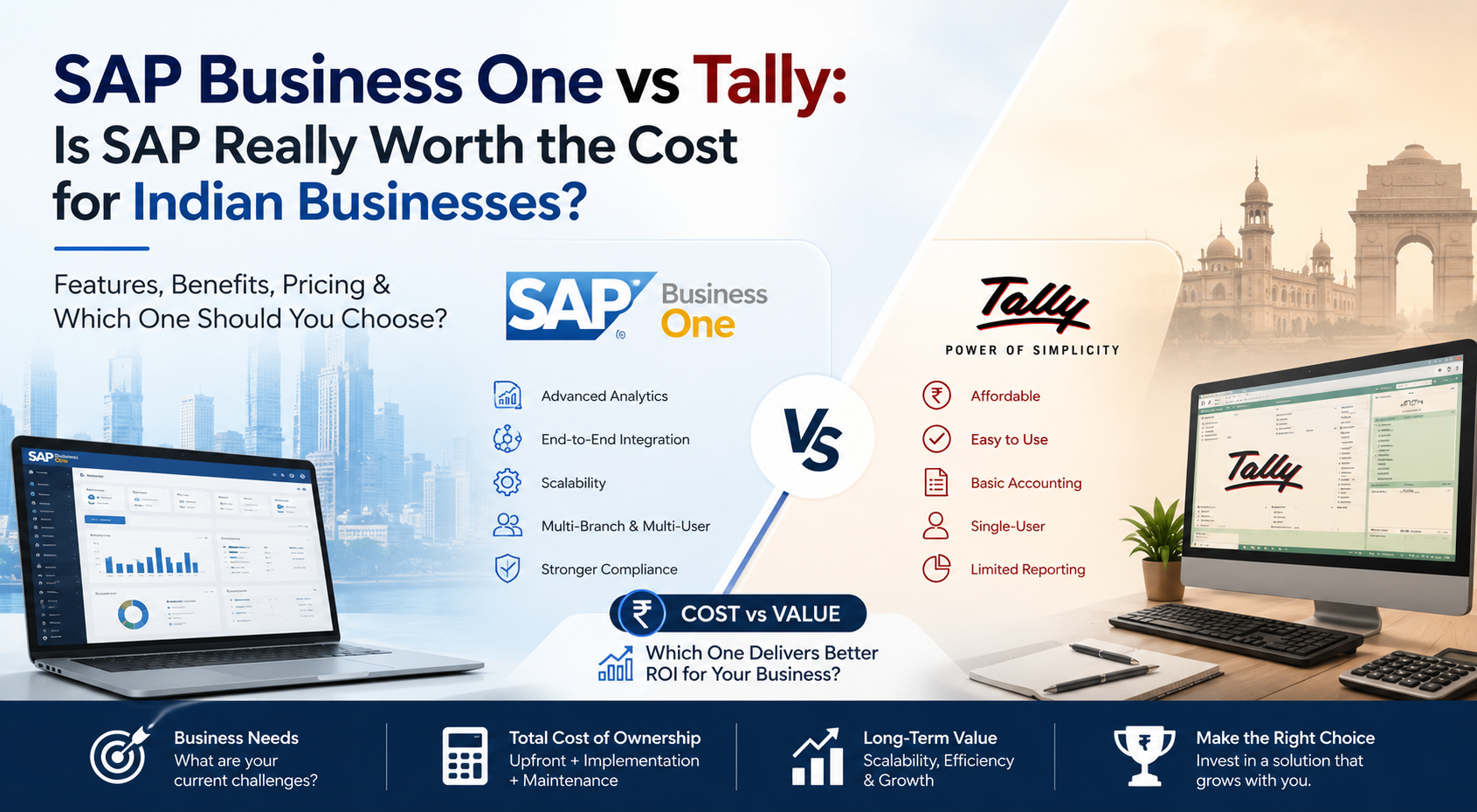
So, comparing Tally and SAP Business One on price alone is like comparing a calculator to a laptop. One does one job very well. The other runs your entire business.
However, that does not mean SAP Business One is the right choice for every business. Consequently, the real question is not "which is cheaper?" It is "which one does your business actually need right now?"
What Does Tally Actually Cost?
Let us start with Tally, since most Indian businesses already know it.
Tally Pricing in India
TallyPrime, the latest version, is available in two editions:
- TallyPrime Single User: approximately ₹18,000 per year
- TallyPrime Multi-User: approximately ₹54,000 per year
These are the license fees. However, the total cost of running Tally in your business is higher than that. Here is a more complete picture:
- License fee: ₹18,000–₹54,000 per year
- Tally on Cloud (for remote access): ₹5,000–₹15,000 per user per year (third-party hosting)
- Add-ons for extra features: ₹5,000–₹50,000+ depending on what you need
- Accountant or data entry staff: ₹15,000–₹40,000 per month per person
- Separate CRM, inventory, or production tools: variable costs for businesses that outgrow Tally
In addition, Tally requires significant manual work. Your team enters data, reconciles records, and compiles reports by hand. That time has a real cost — even if it does not appear on a software invoice.
What Tally Does Well
Tally is genuinely excellent for:
- GST return filing and compliance
- Basic bookkeeping and financial reports
- Simple inventory tracking
- Payroll for small teams
- Businesses with fewer than 10 users and straightforward operations
For these businesses, Tally is cost-effective and easy to use. There is no reason to change — yet.
Where Tally Falls Short
As businesses grow, however, Tally begins to show its limits. For example:
- It does not support production planning or Bill of Materials (BOM) management
- It struggles with large databases and multiple simultaneous users
- It has no built-in CRM or sales pipeline management
- It lacks multi-level approval workflows
- It has no real-time dashboards or advanced analytics
- It cannot manage multi-location operations cleanly
- It does not support mobile access for managers on the move
In other words, Tally is a strong foundation. However, it was not designed to run a complex, growing business end to end.
What Does SAP Business One Actually Cost in India?
Now, let us look at SAP Business One pricing honestly. Yes, it costs more than Tally. But let us understand exactly what you are paying — and what you are getting.
SAP Business One License Cost in India
SAP Business One uses a named-user licensing model. There are two main user types:
- Professional User license: ₹1.5 lakh–₹2.5 lakh per user (one-time, perpetual)
- Limited User license: approximately 40–60% of Professional user cost
So, for a business with 10 users on a perpetual license, the license cost alone is roughly ₹15 lakh–₹25 lakh as a one-time payment.
Implementation and Other Costs
License fees, however, are only part of the picture. Additionally, you need to budget for:
- Implementation and configuration: ₹5 lakh–₹15 lakh depending on complexity
- Data migration from Tally: ₹1 lakh–₹3 lakh
- User training: included or billed separately by implementation partner
- Annual maintenance: 17–22% of license value per year
- Infrastructure (server or cloud hosting): ₹1 lakh–₹3 lakh per year
Therefore, a realistic total first-year investment for a 10–15 user SAP Business One implementation in India is typically ₹20 lakh–₹40 lakh, depending on the complexity of your business.
That is a real number. We are not going to hide it.
But Here Is What That Cost Actually Buys You
SAP Business One does not just replace Tally. Instead, it replaces Tally plus every other disconnected tool your business currently uses.
Consider what a growing Indian business typically pays for alongside Tally:
- Separate CRM software: ₹1 lakh–₹5 lakh per year
- Separate inventory management tool: ₹50,000–₹2 lakh per year
- Separate production planning tool: ₹1 lakh–₹3 lakh per year
- Separate HR and payroll software: ₹50,000–₹2 lakh per year
- Excel-based reporting (staff time): ₹2 lakh–₹6 lakh per year equivalent
- Additional accountant staff for manual reconciliation: ₹2 lakh–₹5 lakh per year
When you add this up, many growing businesses are spending ₹8 lakh–₹20 lakh per year on tools and staff to work around the gaps that Tally leaves. Consequently, the gap between Tally's total cost and SAP Business One's total cost is much smaller than the license comparison suggests.
SAP Business One vs Tally: Feature Comparison
Here is a clear, side-by-side look at what each platform covers:
| Feature |
Tally |
SAP Business One |
| GST Compliance & Filing |
✅ Yes |
✅ Yes |
| E-Invoicing (IRN) |
✅ Yes |
✅ Yes |
| Basic Accounting |
✅ Yes |
✅ Yes |
| Multi-User Support |
⚠️ Limited |
✅ Strong |
| Inventory Management |
⚠️ Basic |
✅ Advanced |
| Production Planning & BOM |
❌ No |
✅ Yes |
| CRM & Sales Pipeline |
❌ No |
✅ Built-in |
| Purchase Order Workflow |
⚠️ Basic |
✅ Full |
| Multi-Level Approvals |
❌ No |
✅ Yes |
| Multi-Location Management |
❌ No |
✅ Yes |
| Real-Time Dashboards |
❌ No |
✅ Yes |
| Mobile App for Managers |
❌ No |
✅ Yes |
| MRP / Demand Planning |
❌ No |
✅ Yes |
| Role-Based Data Security |
⚠️ Basic |
✅ Granular |
| AI-Powered Analytics |
❌ No |
✅ Yes (HANA) |
| Scalability for Growth |
⚠️ Limited |
✅ High |
As the table shows, Tally covers the accounting column very well. However, SAP Business One covers the entire business.
The Real Cost Question: What Is Your Current System Costing You?
Most businesses focus on what SAP Business One costs to buy. However, the more important question is: what is your current system costing you to run?
The Hidden Cost of Staying on Tally Too Long
Consider these common scenarios in Indian businesses that have outgrown Tally:
Inventory errors. Your warehouse records show 500 units. Your Tally shows 420. Your sales team has already committed 480 to a customer. As a result, you face a short delivery, an unhappy buyer, and a manual investigation that takes hours.
GST mismatches. Data entered separately into Tally and your sales tool leads to GSTR-2B mismatches. Consequently, you lose Input Tax Credit (ITC) and receive a notice from the GST department.
Slow month-end closing. Your accounts team spends 5–7 days each month manually pulling data from Tally, your inventory tool, and Excel to close the books. Therefore, management sees last month's numbers three weeks after the month ends.
No production visibility. Your factory manager decides what to produce based on experience, not data. As a result, you carry too much of some materials and run short on others — costing money on both ends.
No real-time sales insight. Your sales head cannot see live pipeline numbers, customer payment history, or margin by product without calling someone in accounts and waiting for a report.
Each of these problems has a measurable cost — in lost sales, wasted inventory, late decisions, and staff hours. Together, they often far exceed the cost of implementing SAP Business One.
So, Does SAP Business One Replace Tally?
Not exactly — and this is the honest answer.
SAP Business One does everything Tally does, and a great deal more. Therefore, from a pure functionality standpoint, SAP Business One fully replaces Tally. Your finance team will find familiar workflows — journal entries, bank reconciliation, GST returns, and financial reports — all within SAP Business One.
However, SAP Business One is not simply a "better Tally." It is a completely different category of software. It is a full business management system, not an accounting tool. As a result, the question is not really "can SAP replace Tally?" The real question is: "has your business grown to the point where you need more than accounting software?"
When Tally Is the Right Answer
Keep using Tally if your business:
- Has fewer than 10 users
- Has straightforward accounting and GST needs
- Does not run complex production or procurement processes
- Is in early-stage growth with limited software budget
There is no shame in staying on Tally. It is a good tool for the right business at the right stage.
When SAP Business One Is the Right Answer
Consider upgrading to SAP Business One when your business:
- Has 10 or more users who need real-time access to business data
- Runs manufacturing, production planning, or complex procurement
- Manages inventory across multiple locations or warehouses
- Needs approval workflows, role-based security, and audit trails
- Wants to replace 3–5 disconnected tools with one integrated platform
- Is planning to grow significantly in the next 3–5 years
- Needs real-time dashboards, sales analytics, and business intelligence
- Operates in pharma, manufacturing, logistics, food and beverage, or chemicals
In short, SAP Business One is the right answer when your business has grown beyond what accounting software alone can support.
How to Think About SAP Business One ROI
The best way to evaluate SAP Business One is not by comparing its license cost to Tally's license cost. Instead, compare the total cost of your current setup — Tally plus all the manual workarounds, extra staff, and disconnected tools — against what SAP Business One delivers.
Typical ROI Drivers After SAP Business One Implementation
Inventory cost savings. Businesses typically report a 15–30% reduction in inventory carrying costs after implementation. Accurate, real-time stock data means you buy what you need — not what you estimate.
Staff productivity. When data entry, report compilation, and inter-department follow-up are automated, your team has more time for work that actually grows the business.
Fewer GST errors. Automated e-invoicing, ITC reconciliation, and GST return preparation eliminate the errors that currently cost time, fees, and compliance risk.
Faster decisions. When management can see live sales, margin, and inventory data instead of waiting for a weekly report, they respond to problems and opportunities faster.
Better customer service. Faster order processing, accurate delivery commitments, and real-time stock visibility improve customer experience — and retention.
Most Indian businesses that implement SAP Business One correctly recover their full investment within 12 to 18 months through these combined savings. From year two onward, the returns compound.
Tally vs SAP Business One: Which One Is Right for Your Business?
Here is a simple way to decide:
Stay with Tally if your main need is accounting, GST compliance, and basic inventory — and your business has fewer than 10 users with straightforward operations.
Upgrade to SAP Business One if your business has grown beyond accounting, you are managing production, multi-location inventory, complex procurement, or a growing sales team, and you need real-time data to make fast, confident decisions.
Consider Zoho One if you are looking for a cloud-based, modular, and affordable platform that covers CRM, accounting, HR, and inventory — particularly strong for businesses focused on front-office operations and customer management. As an Accredited Zoho Partner, Fairfax Solution also helps businesses implement and customize Zoho solutions.
The most important thing is to be honest about where your business is today — and where it needs to go in the next three to five years.
How Fairfax Solution Helps
Fairfax Solution has been implementing SAP Business One for Indian businesses for over 15 years. We have completed 80+ successful implementations across manufacturing, trading, logistics, pharma, food and beverage, and chemicals. As an SAP PE Partner, we bring the implementation discipline and industry knowledge that makes ERP work in the real world — not just in a demo.
We also give honest advice. If your business does not yet need SAP Business One, we will tell you that. Our goal is to help you make the right decision for your business — not the most expensive one.
If you are currently on Tally and wondering whether it is time to upgrade, we offer a free business assessment. We will look at your current setup, understand your growth plans, and give you a straight answer — with full cost transparency.
Conclusion: Cost Is Not the Right Question. Value Is.
SAP Business One costs more than Tally. That is a fact. However, it also does far more than Tally — covering every function of your business in one integrated, real-time system that grows with you.
The right question is not "how much does SAP Business One cost?" The right question is "how much is my current system costing me — in time, errors, missed opportunities, and business limitations?"
For many growing Indian businesses, that honest calculation makes the decision very clear.
Fairfax Solution — SAP PE Partner | Accredited Zoho Partner
Offices: Sector V, Kolkata | Greater Noida West, Uttar Pradesh
Phone: +91 9147082595 | Email: sapsales@fairfaxsolutions.net
Website: fairfaxsolution.com
Frequently Asked Questions
Is SAP Business One worth the cost compared to Tally in India?
For businesses that only need accounting and GST compliance, Tally is cost-effective and sufficient. However, for businesses managing production, multi-location inventory, or complex procurement, SAP Business One delivers far more value. Most businesses recover the investment within 12 to 18 months.
Can SAP Business One replace Tally?
Yes. SAP Business One covers everything Tally does — GST compliance, accounting, inventory — and adds production planning, CRM, multi-location management, approvals, and real-time analytics. It replaces Tally and all the extra tools your business currently uses to fill Tally's gaps.
How much does SAP Business One cost in India?
A realistic first-year budget for a 10–15 user SAP Business One implementation in India is ₹20 lakh–₹40 lakh, covering licenses, implementation, data migration, training, and infrastructure. Subscription options are also available from ₹8,000–₹12,000 per user per month.
How much does Tally cost in India?
TallyPrime Single User costs approximately ₹18,000 per year. The Multi-User license costs approximately ₹54,000 per year. Additional costs include cloud hosting, add-ons, and staff time for manual processes.
Can I migrate from Tally to SAP Business One?
Yes. Fairfax Solution handles complete data migration from Tally to SAP Business One, including opening balances, vendor and customer masters, item masters, and historical transaction data.
Which industries benefit most from SAP Business One in India?
SAP Business One is particularly strong for manufacturing, trading and distribution, logistics, pharmaceuticals, food and beverage, chemicals, and engineering businesses in India.




 July 10, 2026