The UAE is moving toward a new electronic invoicing environment.
For businesses already using SAP Business One, this is more than an accounting change. It is an opportunity to review how invoices, tax information, customer data and ERP integrations are managed.
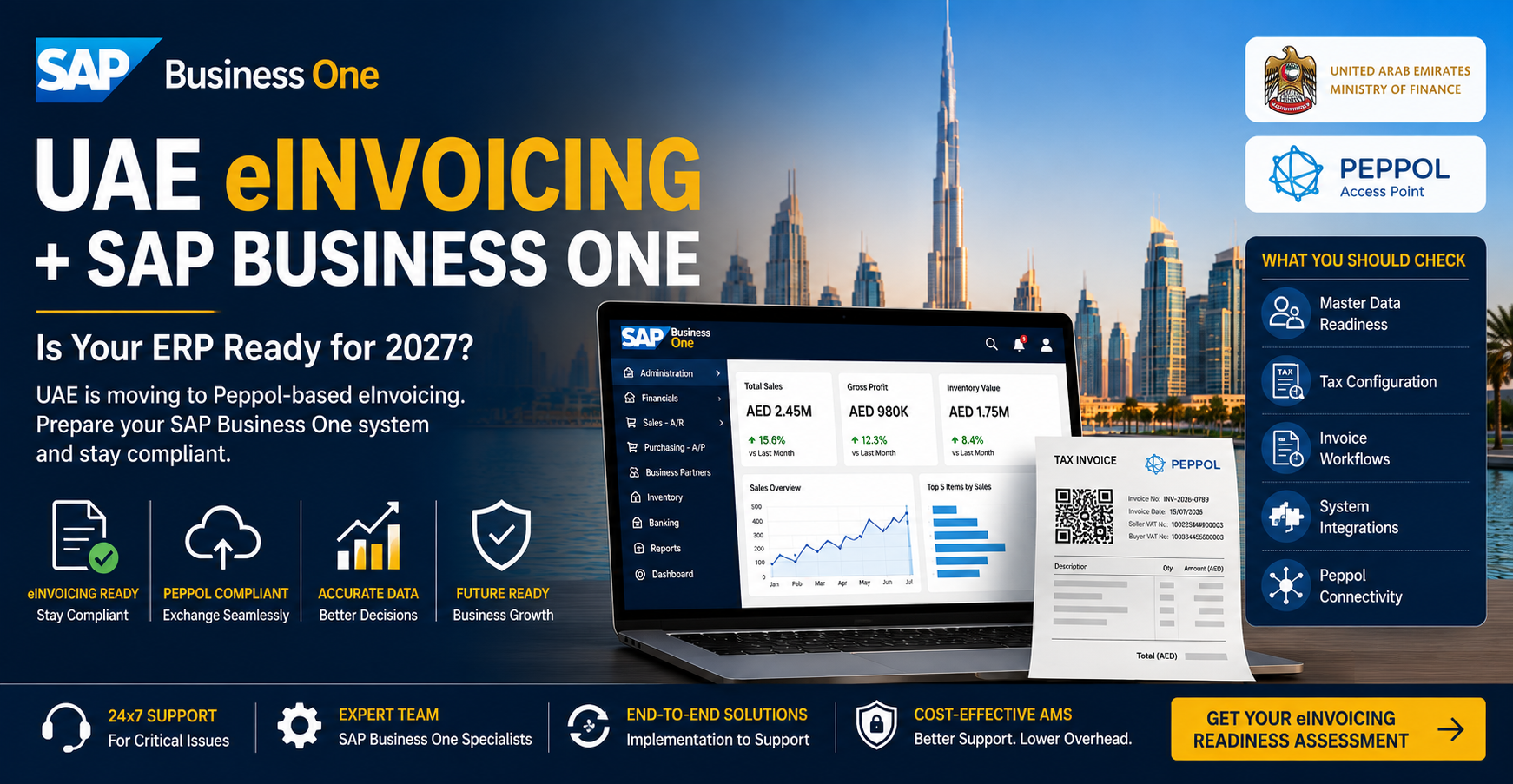
The UAE is introducing a Peppol-based e-invoicing framework, with voluntary usage beginning in July 2026 and mandatory requirements beginning in 2027. SAP's current documentation also reflects UAE support for Peppol-based electronic document exchange.
For companies using SAP Business One in Dubai, Abu Dhabi, Sharjah and other parts of the UAE, now is a good time to assess whether their ERP environment is ready.
What Is UAE e-Invoicing?
Electronic invoicing is the structured electronic exchange of invoice information between businesses.
It is different from simply sending a PDF invoice by email.
A proper e-invoice uses structured data that can be exchanged between business systems through the required electronic invoicing network and service providers.
This means businesses need to look beyond the invoice template itself.
They also need to consider:
- Customer information
- Supplier information
- Tax information
- Invoice data
- Credit notes
- Business partner identifiers
- ERP configuration
- Integration
- Data validation
- Electronic document transmission
SAP's UAE documentation highlights the importance of maintaining tax and legal registration information in business partner master data for electronic invoice processing.
Why SAP Business One Users Should Start Preparing
If your company already uses SAP Business One, the ERP will be an important part of your invoicing workflow.
Your invoices may depend on information stored in:
- Customer master data
- Supplier master data
- Tax configuration
- Item master data
- Company information
- Financial configuration
- Sales documents
If this information is incomplete or inconsistent, electronic invoicing processes can become more difficult.
For example, SAP documentation for UAE electronic document processing identifies the UAE Tax Identification Number as a relevant participant identifier for Peppol exchange.
Therefore, e-Invoicing readiness starts with ERP data readiness.
5 Things SAP Business One Users Should Check
1. Review Your Customer and Supplier Master Data
Start with your business partners.
Check whether important information is complete and accurate.
This can include:
- Legal business name
- Address
- VAT registration information
- Tax identification information
- Country
- Business registration information
- Relevant electronic invoicing identifiers
SAP documentation specifically identifies UAE VAT registration numbers and TIN information as relevant business-partner tax data.
Cleaning this information now can make future implementation easier.
2. Review Your Tax Configuration
Your SAP Business One environment should correctly reflect your current tax processes.
Review:
- VAT codes
- Tax rates
- Tax determination
- Customer tax information
- Supplier tax information
- Credit notes
- Debit notes
- Tax reporting
Do not assume that your existing configuration is automatically ready for every future e-Invoicing requirement.
Your implementation or support partner should review the configuration against the applicable UAE requirements.
3. Check Your Invoice Workflow
Map how an invoice moves through your business.
For example:
Sales Order
↓
Delivery
↓
Invoice
↓
Accounting
↓
Payment
Now identify where the invoice data comes from.
Ask:
- Is customer data complete?
- Are tax details accurate?
- Are invoices generated directly from SAP Business One?
- Are invoices modified manually?
- Are other systems involved?
- Is any information transferred through Excel?
- Is a third-party application involved?
This process mapping can reveal potential integration or data issues before they become urgent.
4. Review Your SAP Business One Integrations
Many UAE companies use SAP Business One alongside other applications.
These may include:
- CRM
- E-commerce
- POS
- Warehouse management
- Banking
- Payment systems
- Logistics platforms
- Custom applications
If invoice information originates outside SAP Business One, those integrations need to be considered as part of the e-Invoicing assessment.
A business may have a perfectly functional SAP Business One installation but still have an invoicing problem because information is coming from another system.
5. Check Your ERP Version and Customizations
Older implementations may contain custom reports, forms, add-ons or integrations that were built specifically for the business.
Before making e-Invoicing changes, document:
- SAP Business One version
- Database platform
- Add-ons
- Custom fields
- Custom reports
- Integrations
- Invoice forms
- Existing electronic document processes
This gives your implementation partner a clear picture of the current environment.
Do You Need to Replace SAP Business One?
Not necessarily.
If your SAP Business One system is already working effectively, the e-Invoicing transition does not automatically mean you need a new ERP.
Instead, your business should first evaluate:
Current SAP B1 setup
→ Data readiness
→ Tax configuration
→ Invoice workflow
→ Integration requirements
→ Approved e-Invoicing service-provider connectivity
→ Testing
→ Go-live
The correct solution will depend on your company's specific ERP environment and applicable UAE requirements.
How Fairfax Can Help With SAP Business One e-Invoicing Readiness
Fairfax Solutions can help UAE businesses review their SAP Business One environment before e-Invoicing requirements become mandatory for their business.
Our assessment can cover:
SAP Business One Configuration
Review relevant finance, tax and invoicing settings.
Master Data
Identify missing or inconsistent customer and supplier information.
Invoice Workflows
Review how sales documents move from order to invoice.
Integration
Identify systems that generate, modify or consume invoice information.
Customizations
Review relevant custom forms, reports, add-ons and processes.
Technical Readiness
Assess the existing SAP Business One environment and identify areas requiring changes or integration work.
AMS Support
Continue supporting the SAP Business One environment after implementation or changes.
Why Prepare Early?
Waiting until the deadline can create unnecessary pressure.
ERP changes often require:
- Business analysis
- Technical assessment
- Data cleaning
- Configuration
- Integration
- Testing
- User training
- Production deployment
Starting early gives your business more time to identify problems.
It also gives finance and IT teams time to work together instead of treating e-Invoicing as an emergency project.
Already Using SAP Business One?
If you already have SAP Business One but are unsure whether your current system is ready for UAE e-Invoicing, Fairfax can review your existing environment.
You do not necessarily need to replace your ERP.
You may simply need to assess, update and integrate your existing SAP Business One environment.
Fairfax provides:
- SAP Business One implementation
- SAP Business One customization
- Integration
- e-Invoicing readiness assessment
- Annual Maintenance & Support
- Technical support
- Functional support
- 24×7 critical support
Our team supports businesses looking for cost-effective SAP Business One expertise in Dubai, Abu Dhabi, Sharjah and across the UAE.
Is Your SAP Business One System Ready for UAE e-Invoicing?
Don't wait until implementation deadlines are approaching.
Get your SAP Business One environment assessed and identify what needs to be changed, integrated or updated.
Talk to Fairfax Solutions about your UAE e-Invoicing readiness.




 August 19, 2026